وَهُوَ ٱلَّذِي خَلَقَ ٱلَّيۡلَ وَٱلنَّهَارَ وَٱلشَّمۡسَ وَٱلۡقَمَرَۖ كُلّٞ فِي فَلَكٖ يَسۡبَحُونَ

“And it is He who created the night and the day and the sun and the moon; all [heavenly bodies] in an orbit are swimming.” al-Anbiyāʾ 21:33

Quran Sky View

Explore the Quran as a sky of light. All 6,236 ayahs mapped in 3D: search by meaning, trace every Arabic root, and read the Arabic with English side by side.

Free · no sign-up · works on your phone

How are you feeling?

Pick a feeling and read the ayahs people turn to in that moment. Each list is chosen by hand.

01

The whole mushaf at once

All 6,236 ayahs, each a point of light. Turn the Quran into a spiral that starts at al-Fātiḥah, a globe where every surah is a band, or a tower stacked in the order it was revealed. Tap any point to read it.

Open the sky →
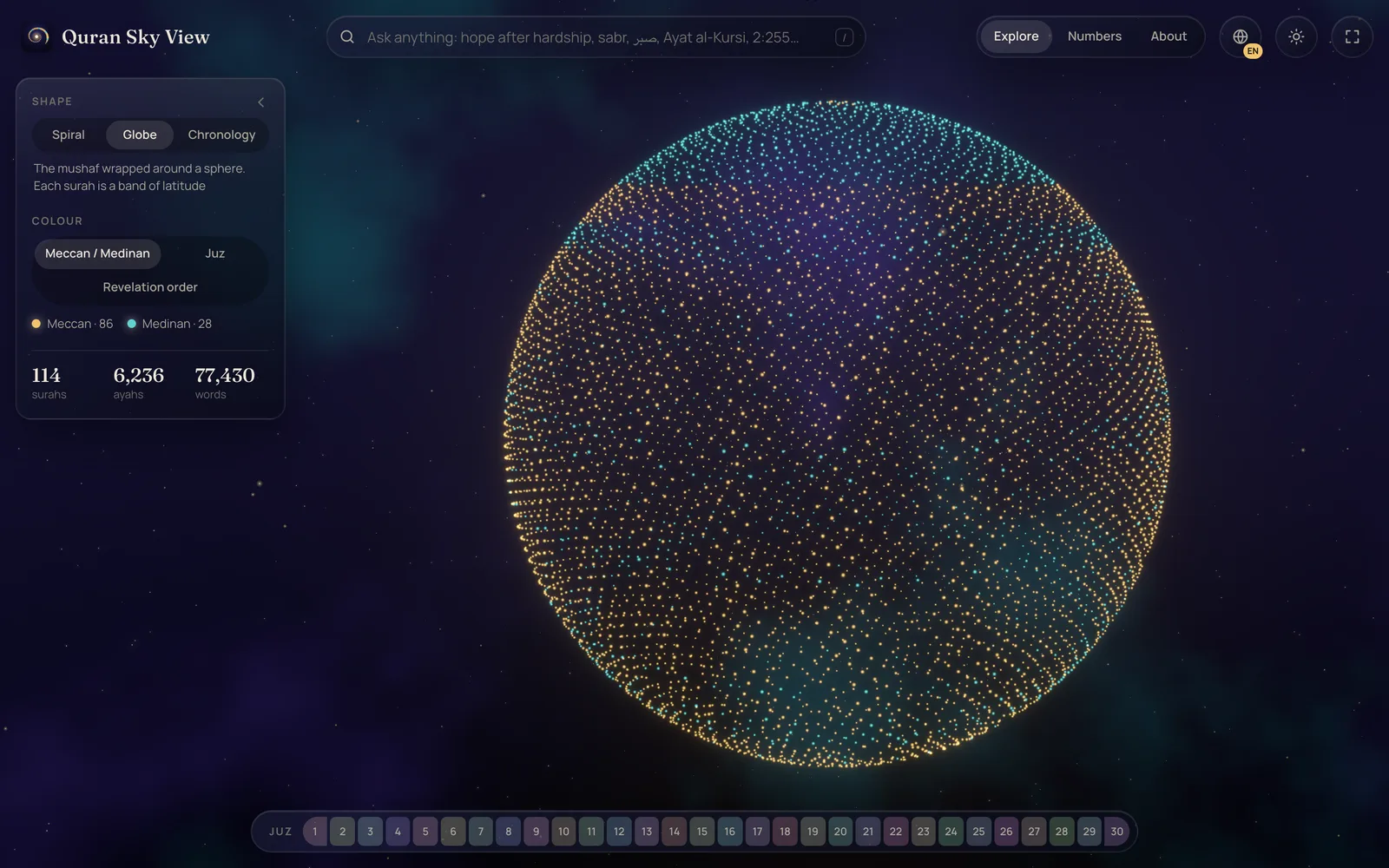
The Quran drawn as a globe of 6,236 points, coloured Meccan and Medinan
02

Ask in your own words

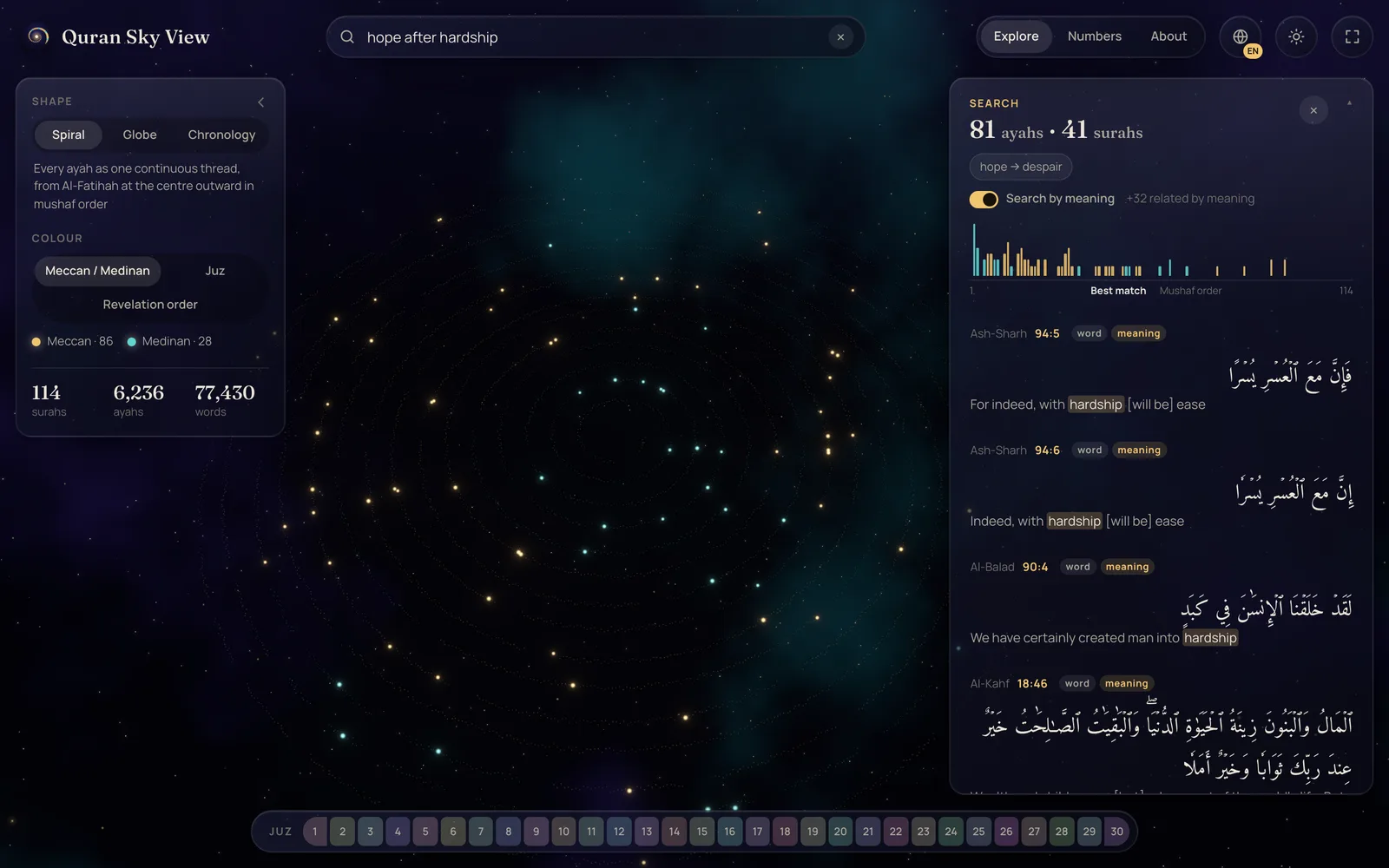
Search the way you think. “Hope after hardship” finds 94:5–6 without those exact words. Type an Arabic root, a transliteration like sabr or taqwa, or a name like Āyat al-Kursī. Every result says why it matched.

Try “hope after hardship” →
Search results for hope after hardship, with 94:5 and 94:6 at the top
03

Read in your language

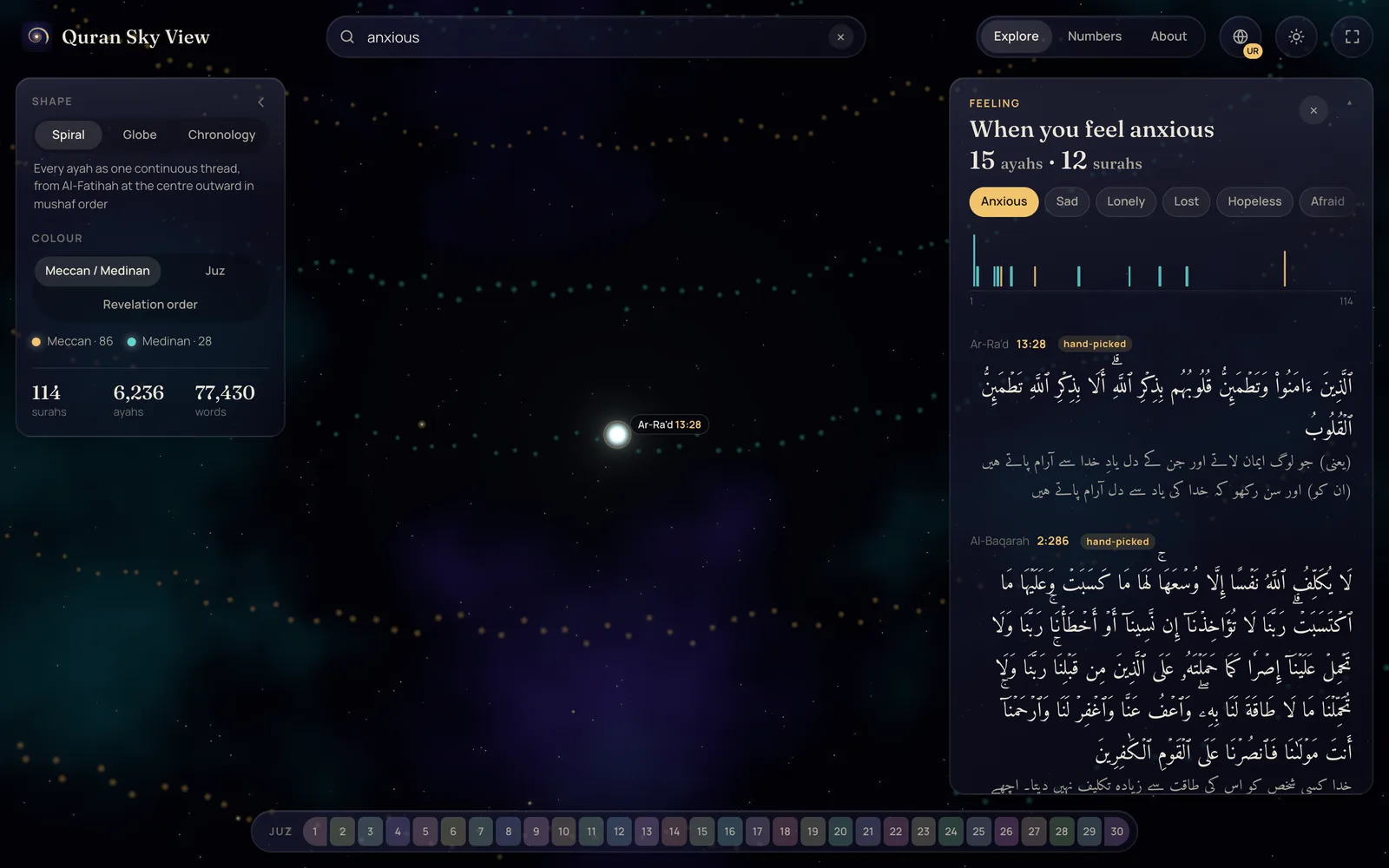
The Arabic text with a translation in 29 languages, including Urdu, Turkish, Indonesian, Bengali, French and German, with the translator named every time. The same reading view opens from any search or feeling.

See “when you feel anxious” →
Ayahs for when you feel anxious, shown in Arabic with an Urdu translation
04

Numbers you can check

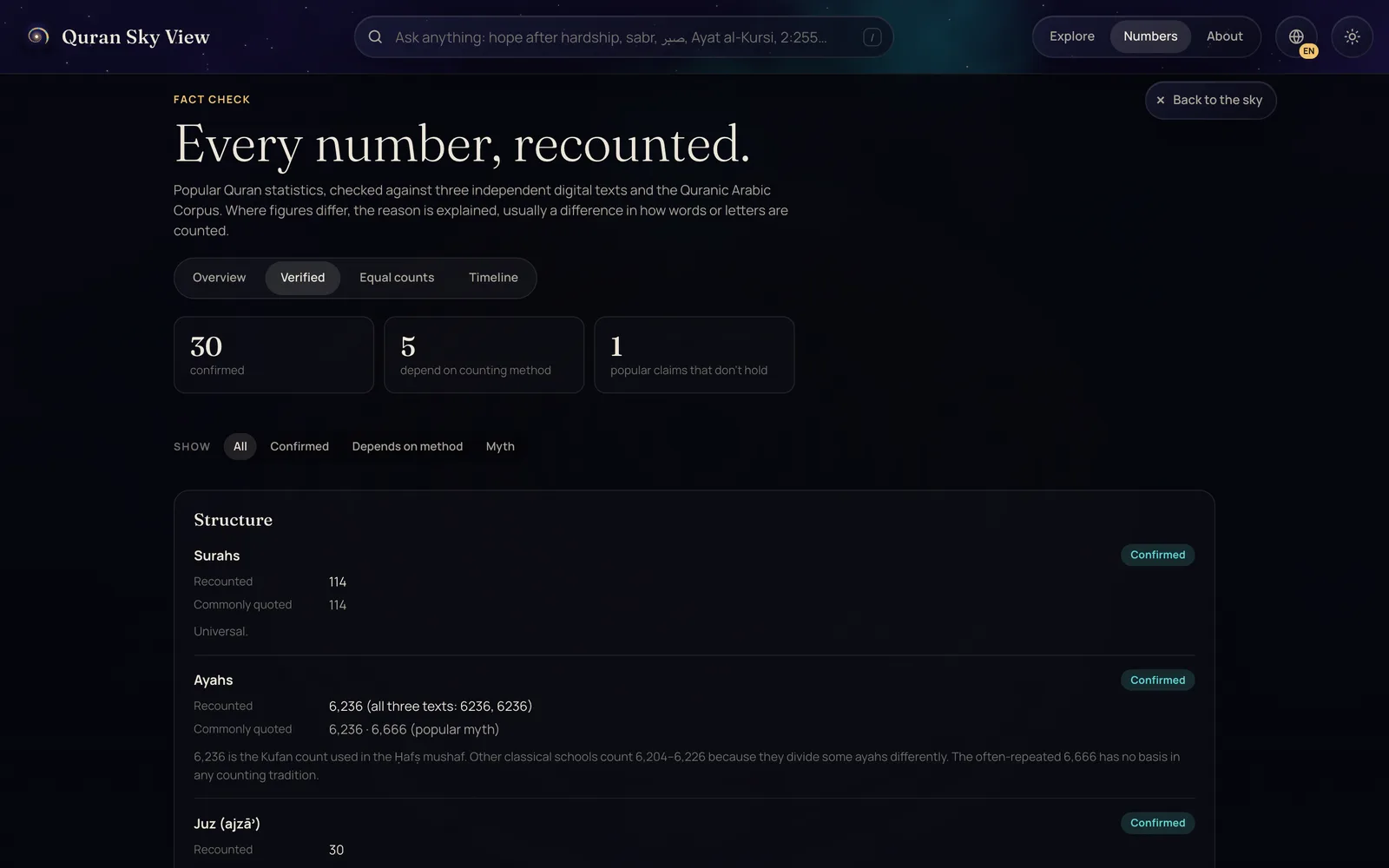
Quran statistics travel fast online. Each one here is recounted from the source text, compared with the figure people quote, and marked as confirmed, dependent on how you count, or a myth.

See the numbers →
The fact-check page: 30 confirmed, 5 depending on method, 1 myth

Sources

Arabic text
Uthmani script, Ḥafṣ reading, from the Noble Qur’an Encyclopedia and Tanzil
Translations
Saheeh International, plus 28 languages from QuranEnc and Tanzil
Word roots
Quranic Arabic Corpus, University of Leeds
Revelation events
Hadith and sīra sources, cited for each event

Quran Sky View is a study aid, not a mushaf. For recitation, please use a printed or certified copy.

Questions

Is it free?

Yes. There is no sign-up, no account and no payment.

Which text and translation does it use?

The Uthmani script in the Ḥafṣ reading, with the Saheeh International English translation. The structure (juz, pages, sajdas) comes from Tanzil, and word roots from the Quranic Arabic Corpus.

How does search by meaning work?

A small open AI model runs inside your browser. It compares the meaning of your question with each ayah’s translation, so it can find relevant ayahs even when the words differ. The first time, it downloads about 30 MB.

Are the statistics accurate?

Every number is recounted from the source text, and compared with figures that are commonly quoted. Where counts differ, usually because of how words or letters are counted, the method is explained.

Does it work on phones?

Yes. It works in any modern mobile browser, with touch controls and a reading sheet designed for small screens.

Step into the sky